
AI Pricing Tool Comparison: The Best Software for Your 2026 Pricing Strategy
Explore this content with AI: ChatGPT | Perplexity | Claude | Google AI Mode
Introduction to AI in Pricing
Artificial Intelligence (AI) is reshaping business strategies across sectors, from customer service to marketing to pricing. As such, AI in pricing has evolved the tools companies use beyond traditional approaches.
AI pricing tools use machine learning to analyze demand, predict price elasticity, and recommend optimal pricing decisions in real time. So, what do AI-powered pricing tools do differently? They continuously analyze data for market and shopper behavior trends to help businesses make better pricing decisions that optimize relevant KPIs (e.g., revenue, profit) and align with customer expectations.
Yet, still, only a few of those AI tools consider all five Revenue Growth Management (sometimes referred to as Net Revenue Management) levers (pricing, price pack architecture, promotions, portfolio mix, and trade terms) holistically, offering an understanding of how one lever may affect the others. A new category of platforms, including Buynomics, is emerging to address this gap by enabling truly interconnected, shopper-centric decision-making.
In this guide, we’ll walk you through the key criteria for evaluating AI pricing tools so you can make the right choice for your business’s AI transformation.
The Need for AI Tools in Pricing
Challenges with Traditional Pricing Methods
Traditional pricing methods, though still used, are often too limited for today’s fast-paced markets. They typically rely on manual processes and human expertise. Here are some standard pricing methods companies use to solve some of their pricing questions and the challenges associated:
- Spreadsheets: Tools like Excel are often used for basic pricing and descriptive data analysis. However, they are prone to human error, lack integrations, and cannot handle complex interdependent pricing scenarios or predict holistically optimal strategies.
.webp?width=736&height=414&name=Buynomics_SRI_16-12-22_V%201-04%20(2).webp)
- Conjoint Studies: Conjoint studies can offer deep insights into consumer preferences, yet they typically have a long setup time, can lack flexibility, and require high costs to update. They are often used for market studies, which, while valuable, are typically project-based, time-intensive, and challenging to scale — making them challenging to quickly adapt to dynamic markets.
Traditional tools also don't allow teams to simulate 'what if' scenarios before a decision is made. There is no way to test a price move, a promotional mechanic, or a pack size change risk-free before it impacts revenue.
Benefits of AI Pricing Tools Over Traditional Methods
AI pricing tools close these gaps, providing the speed, accuracy, scalability, and prescriptive insights that traditional methods lack. They consider more options and make better decisions than a human could by analyzing data in real time to anticipate demand shifts, optimize prices, and suggest specific actions.
The Buynomics Future of RGM Report 2026 found that while AI adoption remains in its early stages in RGM, with 44% of RGM teams piloting limited AI use cases, the organizations already using AI within their RGM strategy cite better scenario planning (25%) and faster decision-making (18%) as emerging benefits.
As a result of these advanced capabilities, AI pricing tools generate a range of outputs, from predictive modeling to prescriptive guidance.
- Predictive Modeling: AI tools analyze historical data to forecast future demand and determine optimal pricing strategies, allowing businesses to anticipate changes and quickly adjust prices when needed.
- Prescriptive Guidance: Beyond prediction, some AI tools (like Buynomics’ Decision Guide) provide prescriptive insights that guide businesses in taking specific actions based on the modeling of their shopper behavior.
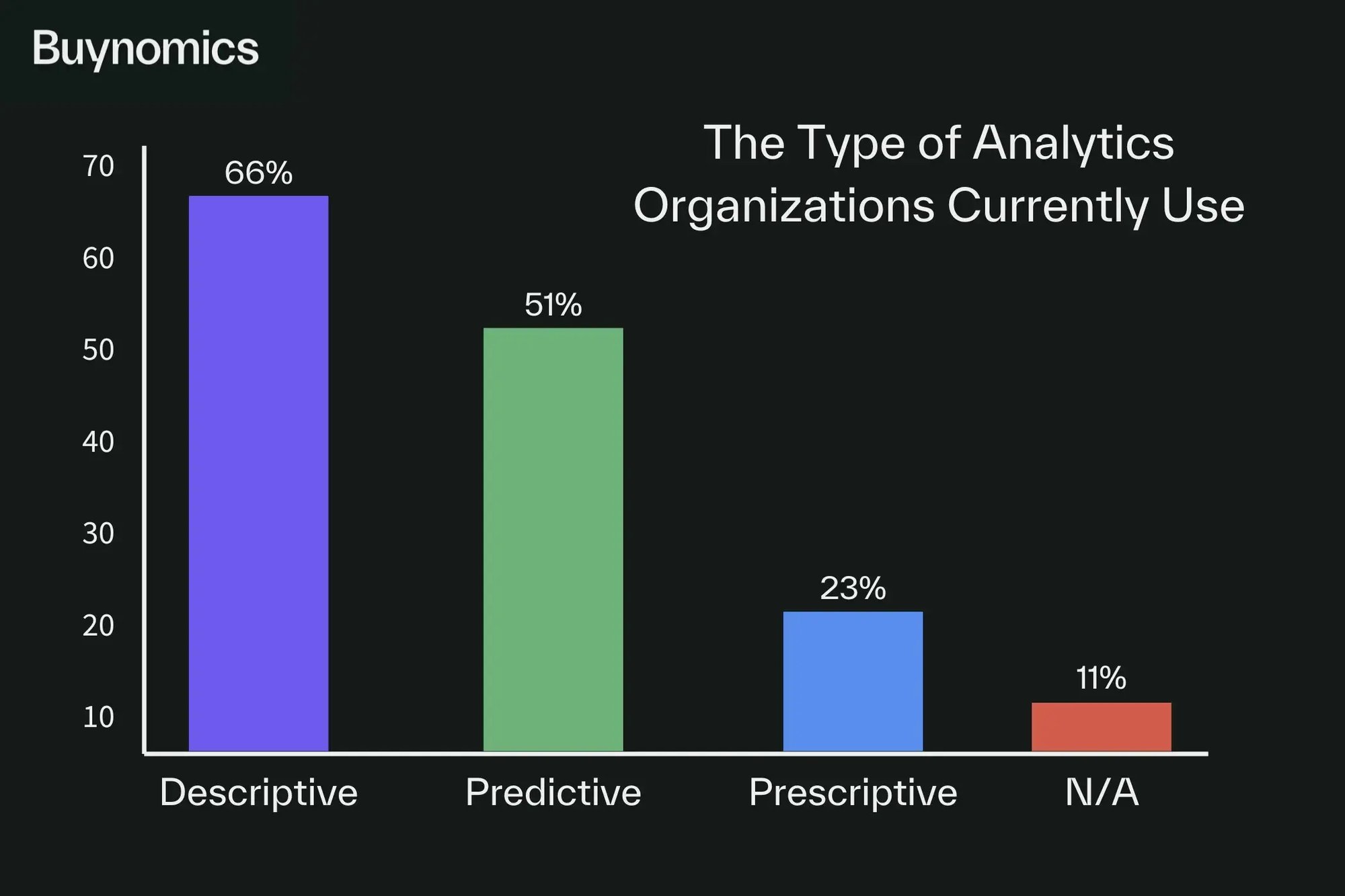
In Buynomics' webinar "From Descriptive to Prescriptive Analytics in RGM," only 23% of participants reported that their organization is using prescriptive analytics.
Watch the full webinar
Top Features to Look for in AI Pricing Tools
Choosing an AI pricing tool requires identifying the features that align with your company’s specific goals. Below are the essential criteria to consider:
Effectiveness in Achieving Goals
Holistic Solution
Opt for tools that can support multiple, ideally all five, RGM levers. A holistic solution integrates various aspects of RGM into a cohesive framework and can provide a comprehensive understanding of market reactions, competitive dynamics, and shopper preferences.
Predictive and Prescriptive Capabilities
Effective AI pricing tools don’t just predict market trends and consumer behavior; they provide actionable recommendations for maximizing growth. Look for solutions that leverage predictive insights AND offer prescriptive guidance on pricing actions, enabling your team to make data-backed decisions.
High Accuracy
The best AI pricing tools will leverage robust data sources and advanced algorithms to achieve high accuracy in predictions and recommendations, ensuring that pricing decisions are based on reliable information.
Scenario Planning
The best platforms let you model alternative strategies across pricing, promotions, and pack architecture before committing to them. AI-powered scenario planning replaces spreadsheet-based "what-ifs" with simulations that capture cross-effects and cannibalization in real time.
Shopper Behavior Modeling
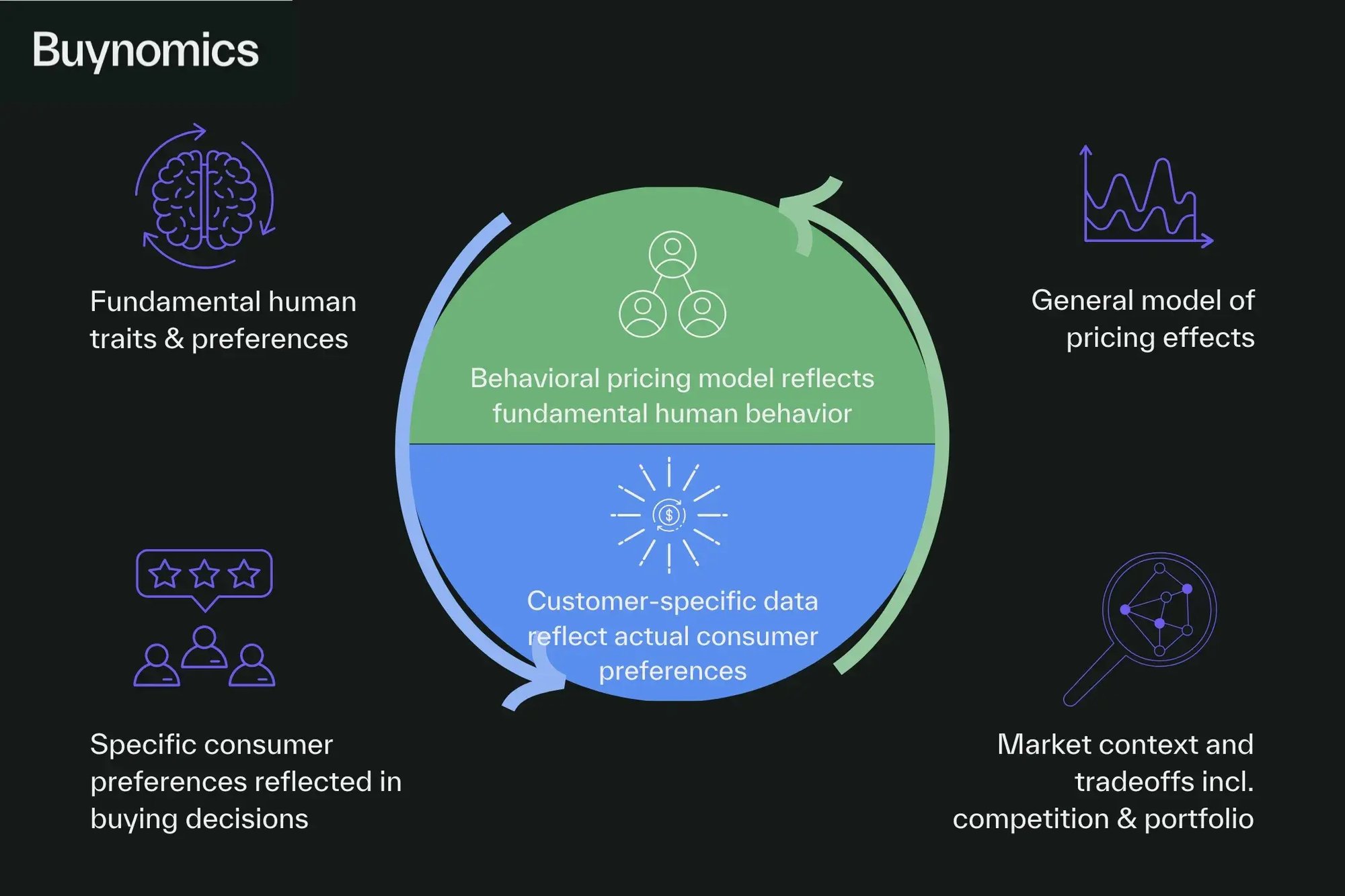
Tools that incorporate behavioral modeling can simulate how shoppers will react to price changes, providing insights into purchasing patterns and preferences. This enables companies to make informed pricing adjustments that resonate with their target market, driving higher engagement and customer satisfaction.
Competitive Response Modeling
Pricing decisions don't happen in a vacuum. Look for platforms that let you simulate how your moves interact with competitor pricing and market positioning, so you can stress-test your strategy against different competitive scenarios before going to market.
Ease of Implementation and Use
Accessibility
Tools that offer easy access to data and insights enable teams and decision-makers to work with the latest information and adjust prices accordingly. The availability of relevant data on demand ensures that pricing strategies can keep pace with rapid changes in the market.
Speed to Insights
Setup and implementation speed are key so your team can access insights quickly. Where conjoint studies or consultancy projects might take months or even years, tools that integrate quickly and minimize the need for extensive training allow companies to move from adoption to application with minimal disruption.
Scalability
Lastly, scalability and flexibility are essential qualities. The best tools are designed to seamlessly grow with business needs, enabling organizations to handle increasing data volumes and expanding use cases while supporting both short-term tactical decisions and long-term strategic planning. Additionally, they can scale across the organization, allowing previously disjointed teams to speak the same language and evaluate the same metrics.
AI Pricing Tool Comparison: Which Tool Fits Your Needs?
When we look at the two broader sections above, we can understand how some pricing tools compare to others according to their features. With a variety of B2B AI pricing tools available, the shift from manual methods to AI-driven solutions has significantly elevated the pricing landscape.
How can you decide which of these tools best fits your needs? To help you make an informed choice, let’s explore the five major categories of AI pricing tools. Once you identify the ideal category, you can compare specific tools within that category using the criteria outlined above.
Dynamic Pricing Tools
Dynamic pricing tools offer a real-time adjustment of prices based on factors like demand fluctuations, competitor pricing, and market trends. They are primarily reactive to competitor movements and demand shifts, adjusting prices as needed to maximize revenue.
Target Industries: eCommerce, retail, travel, and hospitality
Examples: 7Learnings, Intelligence Node, Omnia Retail, Competera
Promotional and Markdown Optimization Tools
Promotional and markdown optimization tools focus on determining the optimal timing and depth of discounts, markdowns, and promotions to manage inventory or drive short-term sales. They are best suited for seasonal and promotional pricing needs, enabling companies to adjust prices based on inventory levels or sales events.
Target Industries: Retail, CPG, and eCommerce
Examples: Revionics, Clear Demand, Retalon, 7Learnings
Competitor Price Monitoring Solutions
Competitor price monitoring solutions are platforms that monitor competitors’ pricing and inventory in real time and provide actionable alerts, often with options for automated price adjustments. They are focused on competitor awareness and reactivity, primarily to support price matching, competitive positioning, and minimum advertised price (MAP) enforcement.
Target Industries: eCommerce and retail
Examples: Prisync, Pricefy, 7Learnings, Price2Spy
Demand Forecasting and Price Optimization Tools
Demand forecasting and price optimization tools predict demand and optimize pricing based on historical data, market trends, and economic indicators to inform inventory management and price setting. They are strong in predictive analysis for demand and price elasticity but primarily focused on simplified volume forecasting rather than exercising truly complex behavioral modeling.
Target Industries: Manufacturers, wholesale, and supply chain
Examples: Blue Yonder, Zilliant, RELEX Solutions.
Holistic Revenue Growth Management
Holistic Revenue Growth Management (RGM), also referred to as Net Revenue Management (NRM), is a comprehensive approach to pricing that integrates multiple RGM levers (price, price pack architecture, promotion, portfolio mix, and trade terms) to consider the interconnected impacts of each lever.
This solution, trained on historical data, combines a deep understanding of shopper behavior, market trends, and economic indicators with predictive and prescriptive modeling to enable the optimization of pricing strategies, promotions, portfolio configurations, and more for data-driven decision-making. Implementing a holistic RGM solution is a significant step in achieving RGM maturity.
Target Industries: CPG, Telecommunications, Retail, and other shopper-focused industries
Example: Buynomics
Key Differentiator: Buynomics is the leading platform for holistic optimization across all RGM levers, delivering predictive and prescriptive insights that help brands make faster, more profitable, customer-focused decisions. Built on its proprietary Virtual Shoppers AI, a market simulation calibrated to real shopper behavior, it lets teams test pricing, portfolio, and promotional scenarios risk-free before committing, including commercial wargaming against competitive moves. This provides actionable insights that go beyond pricing to help businesses boost gross profits by 2%–4% and reduce decision-making time by up to 80%.
Where most RGM approaches optimize levers in isolation — pricing in one tool, promotions in another, portfolio decisions in yet another — Buynomics runs all three from a single model, making the interconnected effects visible before any decision is made. This holistic approach scales with portfolio complexity: whether teams are managing an established range or modeling the commercial impact of rapid portfolio growth, the simulation simultaneously captures cross-effects and cannibalization across the full assortment.
Limitations and Risks of AI Pricing Tools
AI pricing software offers significant advantages over traditional methods, but companies that evaluate these tools with clear eyes will implement them more successfully.
The most common mistake is what Ingo Reinhardt calls the "GenAI Halo Effect" in The Pricing Playbook (Wiley, 2026): assuming that because tools like ChatGPT perform impressively in general tasks, they can also answer specialized commercial questions. They cannot. General-purpose LLMs are not built to predict how shoppers respond to price changes, and using them directly for pricing decisions produces unreliable results. Specialized RGM AI, trained specifically on commercial data and shopper behavior, is a fundamentally different category of tool.
Data quality is a real constraint for any approach. AI pricing models are only as good as the data they learn from, and integrating the sources required for RGM (sell-out data, panel data, conjoint studies, and cost and trade term data) is notoriously difficult to automate and still frequently requires meaningful manual work. Data readiness should be assessed before any platform evaluation begins.
Finally, agentic systems, while advancing rapidly, remain largely in an experimental phase in most companies. Human oversight is still required, and the most effective implementations are those in which AI augments commercial judgment rather than bypasses it.
Governance and Ethics in AI Pricing
Implementing AI in commercial decision-making raises governance questions that any responsible organization should address before deployment.
Transparency of recommendations matters. The best AI pricing implementations, as Reinhardt argues in The Pricing Playbook, do not surface a single black-box output; they present a range of evaluated options with the financial implications of each clearly visible, so that commercial teams and senior leadership can make an informed final decision. Explainability is not a feature; it is a governance requirement for any tool used in high-stakes commercial decisions.
Human decision authority should be preserved by design. The AI's role is to identify options, run scenarios, and surface what the data supports. The strategic call is the commercial team's responsibility.
The Future of AI in Pricing
The trend is clear: AI in pricing is steering businesses away from reactive, competitor-focused models toward proactive, shopper-centric solutions that drive sustainable growth. Companies that implement AI pricing tools, especially holistic Revenue Growth Management solutions, are on the road to RGM maturity.
Reaching full RGM maturity begins with understanding where your business stands today. Our RGM Maturity Assessment provides a customized report comparing your performance to that of your peers and offers practical next steps.
Advanced AI tools are no longer limited to historical data analysis; they now anticipate shopper behavior with predictive and prescriptive insights, simulating how individual customers will respond to changes in price, pack size, or promotional mechanics before they are implemented. Platforms like Buynomics exemplify this shift: rather than relying on price elasticity coefficients or segment averages, Virtual Shoppers AI runs millions of simulated individual shoppers against any commercial scenario, capturing cannibalization, competitive response, and cross-portfolio effects in real time. This is what allows teams to replace spreadsheet-based "what-if" planning with simulation-based decisions that hold up under scrutiny.
The next frontier is agentic AI, systems that do not wait to be asked, but proactively monitor the commercial situation, generate and evaluate scenarios, and surface recommendations autonomously. In The Pricing Playbook (Wiley, 2026), Buynomics co-founder Ingo Reinhardt argues that the most successful companies over the next decade will be those that operate as truly market-led organizations: strategy, portfolio, and pricing decisions driven by a real understanding of how individual shoppers behave - not by internal goals, production constraints, or simplified buyer personas. The AI agent, in Reinhardt's framing, acts as a digital copilot: orchestrating data sources, running simulations, and preparing recommendations, while human teams retain ownership of strategy and final decisions.
Buynomics 3.0 makes this model operational. Its three-layer AI architecture starts with the Virtual Shoppers AI, a simulation engine that models the buying decisions of millions of individual shoppers, capturing how they respond to price changes, promotions, and portfolio shifts before any decision goes to market. On top of that sits a natural language interface, letting commercial teams build and test hypotheses through conversation rather than manual scenario construction. The third layer is the agentic AI: a system that doesn't wait to be asked. It monitors the commercial environment, automatically generates and validates the most relevant scenarios, and guides the next decision without requiring the team to know which question to ask first.
As AI technology advances, the question for RGM teams is no longer whether to adopt simulation-based tools, but how quickly they can shift from reactive analysis to autonomous commercial decision-making, so their time goes where it matters most: owning the strategy.
Take the Next Step to Improving Pricing Strategy
AI pricing software is reshaping how companies approach pricing strategies, moving from from manual scenario planning and spreadsheet-based analysis to AI-powered commercial decision-making at scale.
Buynomics stands out by grounding every pricing decision in simulated shopper behavior: combining prescriptive AI capabilities across pricing, promotions, and pack-price architecture to drive both short-term performance and long-term revenue growth. For companies looking to align their pricing strategy with real market dynamics and actual shopper response, Buynomics 3.0 represents the the next generation of AI pricing softwares.
Buynomics can help you unlock the full potential of AI-powered pricing insights and position your organization for lasting revenue success. Talk to our team to see how Buynomics can take your pricing to the next level.
FAQs
What are the best agentic AI tools for modeling customer behavior?
Most AI pricing platforms rely on statistical models to estimate how customer segments respond, on average, to price changes. A newer category combines agent-based AI simulations that model the buying decisions of millions of individual virtual shoppers with an agentic AI layer that proactively monitors the commercial environment, generates hypotheses, and surfaces recommendations without prompting. Buynomics is among the platforms building in this direction, combining the Virtual Shoppers AI with a natural language interface and an agentic layer designed for autonomous commercial decision-making.
Which AI pricing tools can model the impact of price changes on category revenue?
Accurately modeling the impact of price changes on category revenue requires going beyond single-product calculations. When a price changes, shoppers redistribute across the entire category: switching to alternatives, changing pack size, or exiting the category entirely. AI platforms like Buynomics model these dynamics by simulating how millions of individual shoppers respond to any combination of price, pack, and promotion changes simultaneously, producing an integrated view of category revenue impact rather than isolated product-level estimates.
How can I use AI agents to test new product prices?
AI agents support price testing by running commercial scenarios through a simulation engine before any decision goes to market. Rather than relying on live market tests or historical averages, platforms with agentic capabilities automatically generate and evaluate pricing scenarios, modeling how shoppers respond to a proposed price point across the full portfolio, including cannibalization within your own range and competitive response. The output is a tested recommendation, not a hypothesis.
How do AI pricing tools differ from traditional approaches?
Traditional pricing approaches, built on spreadsheet models and price elasticity coefficients, analyze one lever at a time, in isolation. AI pricing tools model the full commercial picture: how price, promotions, pack size, and portfolio interact simultaneously, and how real shoppers respond to each combination. Decisions that look sound in isolation often underperform in the market because the cross-effects: cannibalization, competitive response, and portfolio dynamics were never modeled. Better AI pricing platforms make those effects visible before the decision is made.
Do you need a holistic RGM platform or a point solution?
The answer depends on the complexity of your commercial decision-making. Point solutions, tools focused on a single lever like promotional ROI or pricing analytics, deliver value quickly for teams with a specific, contained challenge. Holistic RGM platforms are built for organizations that need to optimize pricing, promotions, pack-price architecture, and trade terms in an integrated way, modeling the cross-effects between levers rather than optimizing each in isolation. For companies with multi-SKU portfolios and complex retailer relationships, those interactions are often where the most significant value is lost, and where a holistic platform makes the most impact.


.png?width=520&height=294&name=Website%20Blog%20Featured%20Images%20(7).png)